Report: July 8 – July 15, 2026
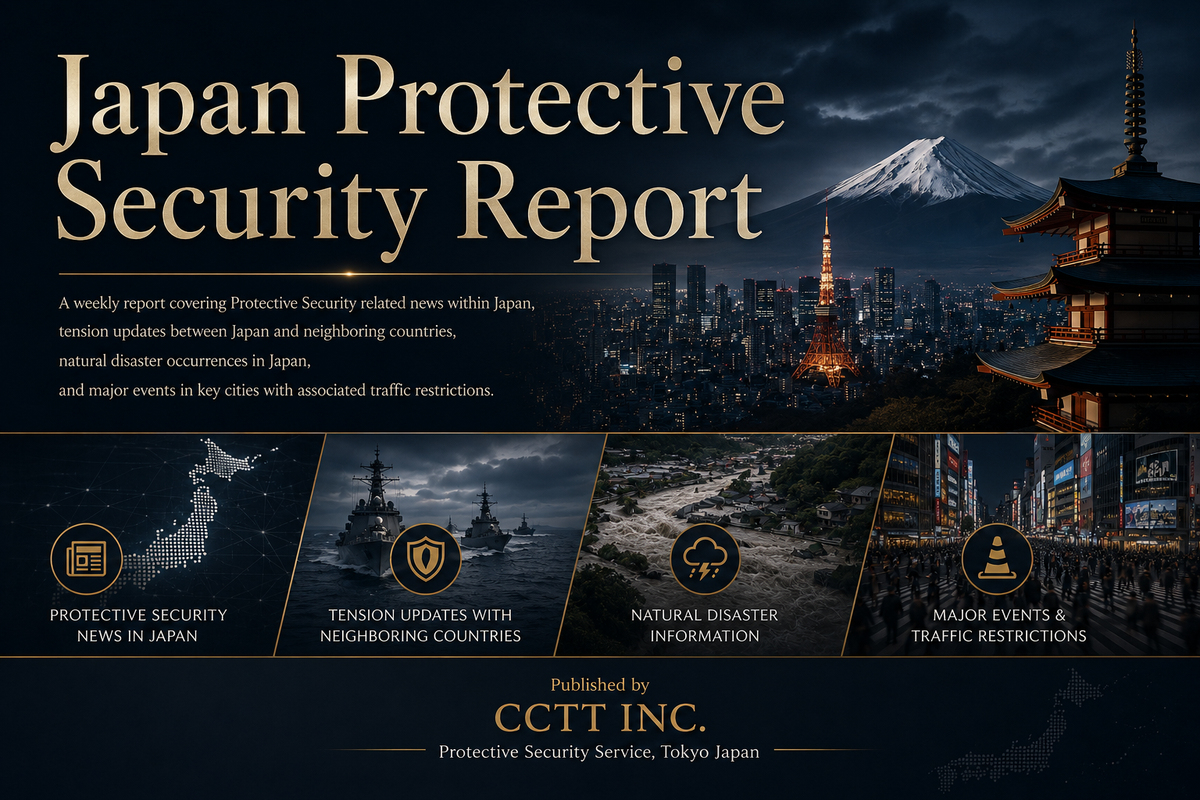
Japan Protective Security Report (Weekly)
Report: July 8 – July 15, 2026
Published: Wednesday, July 15, 2026 (JST)
A weekly English-language OSINT briefing for executive protection professionals, bodyguards, and corporate security managers operating in or visiting Japan.
🔒 Section 1: Weekly Security News Summary
Toyama man arrested for allegedly planning indiscriminate knife attack in Tokyo
Toyama Prefectural Police arrested a 53-year-old man for allegedly planning to travel to Tokyo and carry out an indiscriminate killing using a knife. Investigators said the man had booked a bus to Tokyo and placed a knife in his backpack before police intervened. The case is operationally significant because it shows how pre-incident information, rapid local police response, and transport-route monitoring can prevent a mass-casualty-style attack before the suspect reaches a crowded urban target.
Source: The Japan Times[3]
💡Tips for Professionals:
EP/CP teams should treat intercity transport nodes, highway buses, stations, and arrival terminals as possible transition points for lone-actor threats. For high-profile principals moving through Tokyo, advance teams should monitor not only the immediate venue but also likely arrival corridors and nearby bus or rail terminals. Corporate security managers should ensure venue staff know how to escalate concerning pre-incident behavior, threats, or online statements before an individual arrives on site.
Four injured in knife attack in Oita Prefecture
Four people were injured and taken to hospital after a knife attack near a Tsutaya rental video store in Saiki City, Oita Prefecture. Police arrested a 44-year-old physical therapist on suspicion of violating the swords and firearms control law after officers responded to the scene. The incident reinforces that edged-weapon attacks in Japan can occur in ordinary commercial zones, not only nightlife districts or major metropolitan areas.
Source: Nippon.com / Jiji Press[9]
💡Tips for Professionals:
For visiting executives and families outside major cities, do not assume smaller regional locations are free from sudden violence. EP teams should identify immediate safe ingress points near shopping, restaurant, and entertainment stops, including staffed stores, hotel lobbies, and police boxes. Security trainers should reinforce simple edged-weapon response principles: create distance, move the principal laterally out of the attack line, avoid fixation on the weapon, and prioritize rapid evacuation over engagement.
Kabukicho touting arrest highlights foreign tourist overcharging risk
Tokyo police arrested a Nigerian national on suspicion of persistent touting for an establishment in Kabukicho, one of Tokyo’s most prominent nightlife districts. Police said they had received 91 consultations in the first half of the year involving people forced to pay extremely high sums after being taken to establishments by African-looking touts, already exceeding the total for all of 2025. Most of the complainants were foreign tourists, with total reported losses around ¥100 million.
Source: Nippon.com / Jiji Press
💡Tips for Professionals:
Inbound travelers and visiting principals should be specifically briefed to avoid street touts in Kabukicho, Roppongi, Ueno, and other nightlife areas, regardless of how friendly or multilingual the approach appears. EP teams should pre-select vetted restaurants, bars, and late-night venues rather than allowing spontaneous street-level decisions. Corporate security managers should include nightlife overcharging, card fraud, and coercive payment disputes in Japan travel briefings, especially for first-time visitors.
Japan police and e-commerce firms strengthen fraud information sharing
Japan’s National Police Agency signed an agreement with Mercari, LY, and Rakuten to share information and prevent fraudulent transactions across online shopping, auction, and related e-commerce services. The framework allows the companies to provide information on fraudulent credit cards, malicious accounts, shipping addresses, and suspicious transaction patterns, while police can share risk information to prevent further damage. The move reflects the growing operational overlap between online fraud, stolen payment data, shipping logistics, and organized criminal activity.
Source: The Japan Times[11]
💡Tips for Professionals:
Corporate security teams should treat e-commerce fraud as a potential physical-security issue when it involves repeated delivery addresses, warehouse pickups, or office shipment points. Executive assistants and household staff should verify unexpected deliveries, resale-platform transactions, or high-value purchases linked to principals. EP teams should be alert to fraudulent purchases that create predictable delivery or handoff locations around residences, serviced apartments, and offices.
Cyberattack arrest linked to Kaikatsu Club internet cafe chain
Tokyo police arrested an 18-year-old man over his alleged role in a cyberattack on Kaikatsu Frontier, the operator of the Kaikatsu Club internet cafe chain. Investigators said the attack involved millions of fraudulent commands against an app server and forced the company to suspend some app functions. The case is relevant because internet cafes in Japan are used by travelers, temporary residents, workers, and sometimes people seeking anonymity or short-term shelter.
Source: The Japan Times[1]
💡Tips for Professionals:
EP teams should avoid using internet cafes for sensitive communications, document handling, or contingency workspace unless there is no alternative. Corporate security managers should remind visiting staff that public or semi-public digital environments can expose credentials, itinerary information, and client data. For investigations or duty-of-care cases involving missing persons, internet cafes remain relevant locations to consider, but cyber incidents may affect membership records, access systems, and service continuity.
AI deepfake misuse of celebrities creates reputational and protective-risk concerns
A rights-protection organization found more than 43,000 suspected AI deepfake cases using celebrities’ likenesses without consent during a two-month survey period, with estimated financial losses reaching up to ¥4.5 billion. The issue has prompted increased concern in Japan’s entertainment and publicity-rights sectors. For high-profile individuals, deepfake abuse can create reputational damage, impersonation scams, stalking triggers, and event-security complications.
Source: The Japan Times[12]
💡Tips for Professionals:
EP teams supporting celebrities, executives, influencers, or public-facing principals should include AI impersonation and deepfake monitoring in protective intelligence. Corporate security managers should prepare escalation procedures for fraudulent ads, fake endorsements, or scam campaigns using a principal’s likeness. Security trainers should brief principals and assistants that reputational attacks can generate physical consequences, including angry victims, media convergence, and unwanted approach attempts at public appearances.
Japan eases privacy rules for AI development while strengthening safeguards
Japan enacted revisions to privacy-related rules to allow certain uses of personal data for statistical analysis and AI development while strengthening safeguards against misuse. The revised framework creates new opportunities for AI development but also raises practical questions around data governance, consent, and misuse prevention. For security managers, the change is relevant because personal-data handling, AI training, and privacy incidents can directly affect executive risk, customer trust, and business continuity.
Source: Nippon.com / Jiji Press[20]
💡Tips for Professionals:
Corporate security managers should coordinate with legal, privacy, and IT teams to confirm how employee, customer, and executive data may be used in AI projects. EP teams should ensure that sensitive itinerary, residence, family, and travel information is excluded from AI tools unless strictly controlled. For organizations using AI in Japan, privacy-policy changes should be treated as security events requiring staff training, vendor review, and incident-response readiness.
🌏 Section 2: Japan–Foreign Nations Tension Monitor
1. China – Tension Level: High
Japan joined Australia, Canada, European partners, the Philippines, the United Kingdom, and the United States in a joint statement marking the 10th anniversary of the South China Sea arbitral tribunal award. The statement reaffirmed that maritime disputes must be resolved peacefully and that China’s expansive maritime claims have no legal basis under the award. China responded strongly, and Tokyo’s ties with Beijing were further strained over Japan’s support for the ruling and its cooperation with the Philippines.
Source: Ministry of Foreign Affairs of Japan[32] | The Japan Times[35]
💡Tips for Professionals:
EP teams supporting Japanese, Philippine, Chinese, Taiwanese, defense-sector, or maritime-industry principals should treat South China Sea-related events as higher-sensitivity periods. Corporate security managers should review protest contingency plans near embassies, government offices, defense forums, and maritime-policy events. For executives traveling through Okinawa, Kyushu, or Southeast Asia-facing business routes, keep itineraries flexible and avoid unnecessary public commentary on sovereignty issues.
2. China / Regional Military Posture – Tension Level: Elevated
China’s missile test into the Pacific continued to draw regional concern, with Japan among the governments alarmed by Beijing’s expanding military activity. The test added to broader regional security concerns involving the East China Sea, Taiwan, and the South China Sea. Although the launch did not directly strike Japan, it contributed to a higher-alert environment for maritime and airspace monitoring.
Source: Reuters
💡Tips for Professionals:
For coastal, port, airport, or maritime-facing itineraries, EP teams should check local advisories and security posture before movement. Defense, aerospace, shipping, semiconductor, and critical-infrastructure clients may face increased media, protest, or intelligence interest during weeks of major military signaling. Corporate security teams should reinforce device hygiene and itinerary confidentiality for principals involved in China-sensitive industries.
3. North Korea – Tension Level: Elevated
North Korea reportedly decided on measures to expand its nuclear forces, according to state media cited by Reuters. The announcement followed continued regional concern over North Korea’s weapons development and strategic alignment. Even without a missile incident directly affecting Japan during the reporting period, North Korea remains a standing driver of J-ALERT readiness, public anxiety, and transport-disruption planning.
Source: Reuters[36]
💡Tips for Professionals:
Maintain J-ALERT, NHK World, and local emergency-notification monitoring during all Japan operations. EP teams should ensure principals understand that missile alerts may require pausing movement, sheltering in place, or avoiding windows and open-air spaces. Corporate security managers should verify that hotels, offices, and event venues have simple shelter instructions that can be communicated in English.
4. Russia – Tension Level: Moderate
Russian Education Minister Sergey Kravtsov visited Etorofu Island, one of the Russian-controlled islands claimed by Japan, marking the first visit in two years by a Russian cabinet minister to the disputed island chain. The visit drew Japanese attention because the Northern Territories issue remains a persistent source of Japan-Russia tension. Separately, reporting indicated that expelled Russian intelligence personnel may be operating from Japan, reinforcing concerns about Japan’s counterintelligence environment.
Source: Nippon.com / Jiji Press[44] | Nippon.com / Jiji Press[50]
💡Tips for Professionals:
Corporate security teams supporting defense, energy, sanctions, technology, or diplomatic clients should treat Russia-linked exposure as both a reputational and counterintelligence risk. EP teams operating near embassies, government offices, and policy events should maintain alternate routes and avoid curbside dwell time. Sensitive meetings should use controlled venues, clean-device procedures, and strict need-to-know itinerary sharing.
🌋 Section 3: Natural Disaster Report
Typhoon Bavi affects Okinawa and Japan’s southwestern islands
Typhoon Bavi approached and affected Japan’s southwestern islands during the reporting period, bringing strong winds, high waves, and heavy rain risk to Okinawa and surrounding island areas. NHK World reported that the powerful typhoon could approach Okinawa over the weekend, while Jiji reporting later said Bavi hit the Okinawa islands. Reuters reporting also described Japan’s southwestern islands as being on high alert as the storm approached.
Source: NHK World | Nippon.com / Jiji Press | Reuters via Internazionale
💡Tips for Professionals — Natural Disaster / Operational Continuity:
For Okinawa, Miyako, Ishigaki, and other southwestern island itineraries, treat typhoon approach windows as movement-control periods rather than ordinary weather events. Confirm flight, ferry, bridge, and local road status before departure, and avoid coastlines, exposed bridges, and low-lying roads during wind and wave warnings. EP teams should prepare indoor holding plans, backup accommodation, power-bank reserves, and food/water contingencies in case principals are stranded by flight or ferry cancellations.
📅 Section 4: Upcoming Major Events & Traffic Restrictions
Tokyo
- Tokyo Big Sight event schedule – July 15 (Wed) – July 22 (Wed), 2026
- Location: Tokyo Big Sight, Ariake/Odaiba area.
- Traffic: Large exhibitions and venue events can increase taxi queues, charter-bus loading, and crowding on Yurikamome and Rinkai Line services. Morning opening and late-afternoon closing waves should be treated as higher-friction movement windows.
- Source: Tokyo Big Sight
- Tokyo Dome City facility closure notice – July 15 (Wed) – July 17 (Fri), 2026
- Location: Tokyo Dome City, Bunkyo Ward.
- Traffic: Some facilities are closed for maintenance and exhibition replacement. While this is not a major traffic restriction, facility closure can affect planned indoor holding points, family itinerary timing, and pedestrian flow around alternative attractions in the area.
- Source: Tokyo Dome City[54]
- Tokyo Metropolitan Police Department traffic information portal – Continuous, next 7 days
- Location: Tokyo metropolitan area.
- Traffic: MPD traffic pages should be checked on the day of movement for event-related restrictions, incident information, and road-safety notices. If event-specific pages are inaccessible or incomplete, cross-check organizer and ward-level official notices.
- Source: Tokyo Metropolitan Police Department
Tips for Professionals — Tokyo:
For Ariake and Odaiba movements, pre-select pickup points away from the main Tokyo Big Sight entrances and allow extra time during morning and late-afternoon peaks. Around Tokyo Dome City, verify facility status before using attractions, halls, or indoor areas as family-programming or holding points. EP teams should check MPD, venue, and ward pages on the day of movement because short-notice traffic controls may not be visible in general event listings.
Osaka / Kansai
- Kansai-area rail and Shinkansen operational monitoring – Continuous, next 7 days
- Location: JR West network, including Kansai-area routes and Shinkansen connections.
- Traffic: Weather, equipment issues, and incidents may affect rail movements. Teams using rail for principal or staff movement should confirm status before departure and again before transfer.
- Source: JR West Traffic Information
Tips for Professionals — Osaka / Kansai:
Rail-dependent itineraries should include alternate road or air plans before the principal enters the station. During typhoon or heavy-rain periods, confirm whether delays affect both the local line and onward Shinkansen connections. Corporate security teams should avoid scheduling tight rail-to-airport transfers during severe-weather windows.
Okinawa / Southwestern Islands
- Typhoon Bavi movement and transport-disruption monitoring – July 15 onward, monitor residual effects
- Location: Okinawa, Miyako, Ishigaki, and surrounding island areas.
- Traffic: Flight, ferry, bridge, and local road operations may be affected by residual typhoon conditions, high waves, and weather-related cleanup or delay recovery.
- Source: NHK World | Nippon.com / Jiji Press
Tips for Professionals — Okinawa / Southwestern Islands:
For island movements, do not assume normal transport resumes immediately after the storm center passes. Confirm ferry restart timing, airport backlog, hotel availability, and road debris conditions before moving principals. If a principal must travel, build in a fallback overnight plan and avoid itineraries that require same-day inter-island connections.
Nagoya / Central Japan
- Central Japan expressway disruption monitoring – Continuous, next 7 days
- Location: NEXCO Central jurisdiction, including Tokai and Chubu corridors.
- Traffic: Weather-related restrictions, traffic incidents, and congestion can affect movement between Nagoya, industrial sites, and regional airports.
- Source: NEXCO Central
Tips for Professionals — Nagoya / Chubu:
For executive movements between Nagoya and surrounding industrial hubs, prepare alternatives that avoid single-point-of-failure interchanges. During heavy rain or typhoon-related weather, confirm road conditions earlier than usual and authorize drivers to reroute when delay thresholds are met. Maintain offline route options in case mobile navigation becomes unreliable.
Japan Protective Security Report (Weekly)
This report is based on open-source intelligence (OSINT) gathered from publicly available, high-credibility sources. It does not constitute legal advice, and CCTT INC. makes no warranty regarding completeness or accuracy. Operational decisions should always incorporate real-time local intelligence.
CCTT INC. – Protective Security Service, Tokyo Japan
VIP/Executive Protection | Celebrity Protection | Vehicle and Driver Arrangement | Airport Service Arrangement | Security Consulting | Security Management | Security Education/Training, etc.