Report: July 29 – August 5, 2026

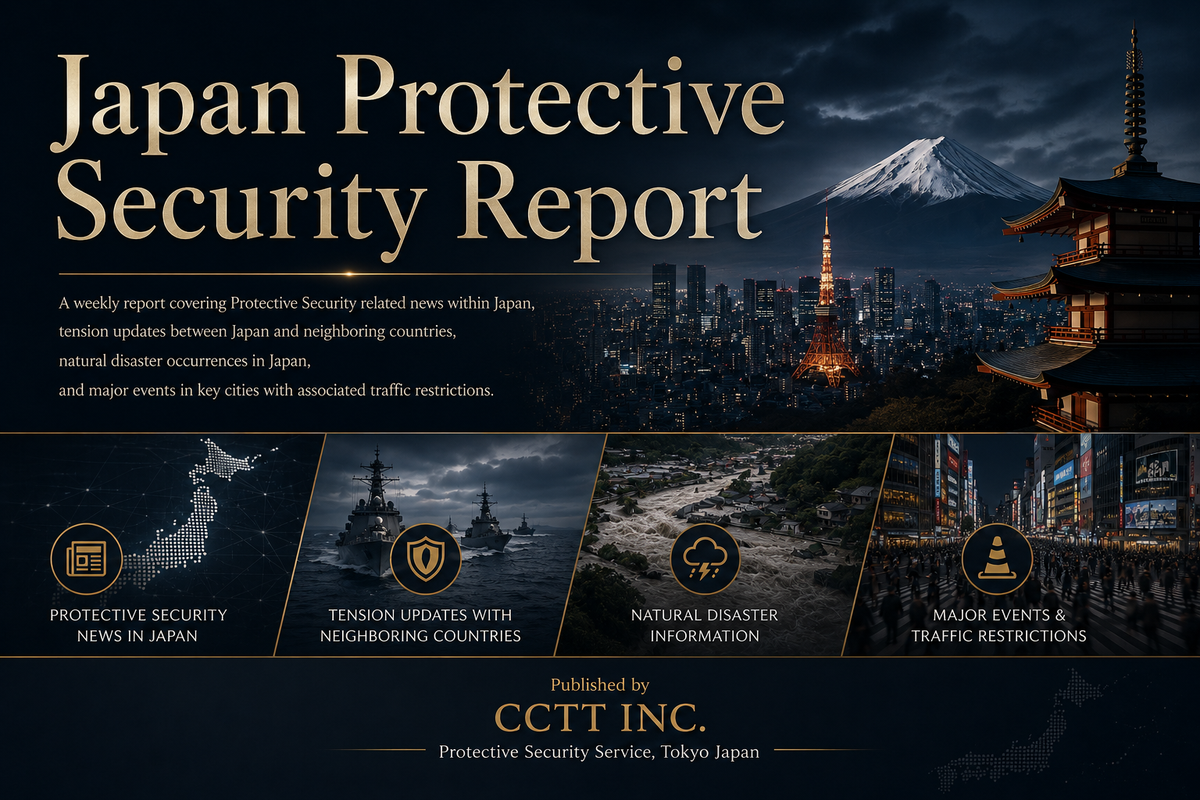
Japan Protective Security Report (Weekly)
Report: July 29 – August 5, 2026
Published: Wednesday, August 5, 2026 (JST)
🔒 Section 1: Weekly Security News Summary
Japan Launches National Intelligence Bureau — First Centralised Intelligence Body Since 1945
Japan formally stood up its National Intelligence Bureau (NIB) on July 31, together with a National Intelligence Council chaired by the Prime Minister. The new structure consolidates assessment and coordination functions previously scattered across the Cabinet Intelligence and Research Office, the National Police Agency, the Ministry of Defense and the Ministry of Foreign Affairs. Officials have described the launch as groundwork for further steps, potentially including anti-espionage legislation and a dedicated foreign intelligence service. The reorganisation is the most significant change to Japan's intelligence architecture in eight decades.
Source: The Japan Times, Nippon.com
💡Tips for Professionals:
Expect gradual tightening of vetting, information-handling and facility-access expectations for contractors and foreign nationals operating around Japanese government and defence-adjacent sites. Corporate security managers supporting foreign principals should review how client itineraries, biographical data and advance plans are stored and shared, since counter-intelligence attention to foreign-linked activity is likely to increase. EP teams should also anticipate renewed civil-liberties protest activity around Nagatachō and the Prime Minister's Office as implementing rules are published.
Cabinet Approves 2026 Defense White Paper: China Framed as Greatest Strategic Challenge
The Cabinet approved Defense of Japan 2026 on August 4. The document again characterises China as an unprecedented and greatest strategic challenge, and places new emphasis on Chinese military projection beyond the First Island Chain into the wider Pacific. For the first time the public digest carries a dedicated section tracing the deepening of China–Russia military cooperation, covering joint naval exercises, long-range bomber patrols and reciprocal participation in each other's drills. The paper also states that North Korea has continued supplying Russia with ballistic missiles, artillery ammunition and other materiel, and links Japan's accelerated force build-up to economic security and industrial growth.
Source: The Japan Times, Ministry of Defense
💡Tips for Professionals:
White paper release weeks reliably generate both nationalist and anti-militarisation demonstration activity in central Tokyo, most often near the Ministry of Defense (Ichigaya, Shinjuku Ward), the Diet Building and Chinese diplomatic premises in Minato Ward. Build alternate ingress and egress options for principals with meetings in those districts through mid-August. Briefing packs for inbound executives should note that Japan's threat framing has hardened, which affects export-control, technology-transfer and due-diligence conversations more than it affects day-to-day physical risk.
NPA First-Half 2026 Crime Data: Recorded Offences Up Again, Fraud Losses at Record High
The National Police Agency released provisional penal-code crime statistics for January–June 2026 on July 30, followed by special-fraud and traffic figures on July 31. Recorded penal-code offences rose 4.8 per cent year-on-year to 383,364 cases, the continuation of a multi-year upward trend since the pandemic low. Special fraud ("tokushu sagi") reached 22,031 recognised cases with losses of roughly ¥181.6 billion — both the worst figures ever recorded, equating to well over ¥1 billion in losses per day. Social-media-based investment fraud was the single largest category at 5,893 cases and approximately ¥79.7 billion in losses.
Source: National Police Agency
💡Tips for Professionals:
Fraud is now the dominant, statistically measurable threat to principals and their households in Japan — far more likely than violent crime. Household staff, family offices and elderly family members of high-net-worth principals should receive a standing brief that Japanese police, prosecutors and courts never request cash, gift cards or electronic money by telephone. For corporate security managers, the SNS-investment-fraud surge is a direct social-engineering indicator: the same pretexting techniques are used against executives' personal accounts before being turned on corporate systems.
National Police Agency Warns of Fraud and Disinformation Exploiting the Kumamoto Earthquake
On July 29, one day after the Kumamoto earthquake, the NPA issued a public warning about online disinformation and fraud exploiting the disaster. Reported patterns included bogus donation appeals soliciting payment in electronic money, fabricated rescue requests posted under the identities of victims, AI-generated imagery of purported damage, and door-to-door solicitations posing as repair contractors or relief collectors. The government also asked major platform operators to act on the circulating false material. Claims attributing the earthquake to artificial causes spread widely in the first 48 hours.
Source: National Police Agency
💡Tips for Professionals:
In the first hours of a Japanese disaster, open-source social feeds are actively hostile terrain — treat unverified imagery and rescue appeals as unusable for decision-making. Pre-designate authoritative feeds for your operations centre (JMA, the Fire and Disaster Management Agency, prefectural police, NHK) and route principal-safety decisions through those only. Brief travelling staff that unsolicited approaches for disaster donations, in person or online, should be declined without exception.
NPA Publishes Updated Stalker Countermeasures Status as Revised Anti-Stalking Act Takes Full Effect
The National Police Agency published an updated implementation review of its comprehensive stalker countermeasures package, dated July 28 and posted to its press-release index on August 3. It follows the phased entry into force of the revised Anti-Stalking Regulation Act: since December 30, 2025, non-consensual location tracking using item-finder tags is a regulated act and police may issue warnings on their own authority; since March 10, 2026, prefectural police chiefs may formally request that third parties refrain from passing a victim's address or social-media account details to a person assessed as likely to commit stalking. Employers of victims and heads of schools attended by victims now carry an explicit duty of effort to provide support.
Source: National Police Agency
💡Tips for Professionals:
The information-provision restriction is directly operable for celebrity and executive protection in Japan: with a police request in place, hotels, venues, management agencies and building administrators have a clear legal basis to refuse enquiries about a protected person's whereabouts. Counter-surveillance sweeps of principal vehicles, luggage and personal effects for Bluetooth trackers should now be routine rather than exceptional, and any tag discovered is evidence supporting a criminal complaint. Advance teams should establish a named point of contact at the local police station before any high-profile appearance, rather than after an incident.
Joint Alert Issued on North Korean IT Workers Infiltrating Corporate Payrolls
Japan issued a fresh advisory on July 31 warning governments, companies and other organisations about North Korean IT workers who obtain remote software and engineering contracts under false identities. The advisory describes the use of forged or borrowed credentials, third-country intermediaries and proxy interviewees to pass recruitment screening, with revenue flowing to Pyongyang's weapons programmes and, in some cases, embedded workers going on to steal data or extort employers. Japanese firms outsourcing development work and using freelance platforms were specifically flagged as exposed.
Source: Ministry of Foreign Affairs, National Police Agency
💡Tips for Professionals:
This is an insider-threat problem that reaches physical security, not only IT: a fraudulently onboarded remote engineer can hold credentials to badge systems, CCTV platforms, visitor-management databases and executive travel calendars. Security managers should confirm that identity-proofing for remote hires is equivalent to that applied to on-site staff, and that access to protective-operations systems is never granted on the strength of a remote-only verification. Where a principal's schedule lives in a cloud tool, audit exactly who holds access and from which jurisdictions it is reached.
🌏 Section 2: Japan–Foreign Nations Tension Monitor
1. China – Tension Level: High
Friction ran across maritime, energy and defence-policy tracks this week. On July 29 the Chief Cabinet Secretary confirmed that China Coast Guard vessels had been operating intermittently in Japan's exclusive economic zone south of Yonaguni Island while asserting Chinese rights there; Tokyo lodged a protest through diplomatic channels. On July 31 the Ministry of Foreign Affairs issued a statement on renewed Chinese movement toward unilateral resource development on the Chinese side of the East China Sea median line, and again pressed Beijing to resume negotiations on implementing the 2008 bilateral agreement. The August 4 defense white paper then named China as Japan's greatest strategic challenge and highlighted expanding Chinese naval and air activity beyond the First Island Chain. Chinese government vessels continue near-daily presence in the Senkaku contiguous zone, a pattern that set a record in 2025 at 357 of 365 days.
Source: Ministry of Foreign Affairs, Japan Coast Guard, The Japan Times
💡Tips for Professionals: Maintain elevated situational awareness and reduced pattern predictability around the Chinese Embassy in Minami-Azabu (Minato Ward) and Chinese consulates in Osaka, Nagoya, Fukuoka and Sapporo, where protest and counter-protest activity clusters after each publicised incident. Advise principals of Chinese nationality, and Japanese principals with China-facing business exposure, to keep a low public profile on territorial and Taiwan-related topics. Begin advance planning now for August 15, the war-end anniversary: it reliably produces nationalist gatherings, counter-protests and heavy police deployment around Yasukuni Shrine (Kudanshita, Chiyoda Ward) and draws diplomatic reaction from both Beijing and Seoul. Any principal movement through Chiyoda Ward on that date needs a route that does not depend on Yasukuni-dōri.
2. North Korea – Tension Level: High
Pyongyang's principal manifestation in Japan this week was non-kinetic. The July 31 multi-agency advisory on North Korean IT workers described a mature revenue-generation and intrusion pipeline operating through remote employment in Japanese and allied firms. The August 4 defense white paper separately assessed that North Korea continues to transfer ballistic missiles, artillery ammunition and other equipment to Russia, deepening a military relationship that Tokyo now treats as a combined rather than separate planning problem. No ballistic missile launch affecting Japanese territory or its exclusive economic zone was reported during the reporting period.
Source: Ministry of Foreign Affairs, The Japan Times
💡Tips for Professionals: Quiet launch weeks are the right time to test, not relax, alerting procedures — confirm every team member has J-Alert and NHK World push notifications enabled and knows the nearest hardened structure or basement at each recurring venue. For corporate clients, the IT-worker advisory should trigger a review of who holds remote administrative access to systems that contain principal movement data.
3. Russia – Tension Level: Elevated
Russian military aviation activity around Japan remained persistent into the reporting period, following an airspace violation over islets claimed by Tokyo on July 25 and a Tu-95 deployment escorted by Su-35 fighters over the Sea of Japan on July 21, both of which drew Air Self-Defense Force scrambles. A joint Russian–Chinese naval patrol transited waters near Japan on July 28. On July 29 the ASDF launched an emergency scramble over the East China Sea in response to a suspected airspace violation, without publicly identifying the aircraft. The August 4 white paper's new China–Russia section formalises Tokyo's assessment that the two are operating with increasing coordination around the Japanese archipelago.
Source: The Japan Times, Ministry of Defense
💡Tips for Professionals: Russian and joint Russia–China activity is concentrated in Hokkaidō, the Sea of Japan coast and the Nansei Islands, and rarely produces a direct threat to principals in the metropolitan corridors. The practical impact is episodic airspace and airport disruption in regional Japan — build schedule margin into itineraries that depend on Hokkaidō or Nansei domestic flights, and confirm alternates before committing a principal to a same-day return.
🌋 Section 3: Natural Disaster Report
1. Reiwa 8 Kumamoto Earthquake — Continuing Aftershock Sequence and Recovery (Kumamoto Prefecture, Kyūshū)
The M7.1 (JMA magnitude) earthquake that struck 5 km east of Uto, Kumamoto Prefecture at 16:27 JST on July 28 at a depth of 10 km dominated the reporting period. JMA recorded maximum seismic intensity 7 in Uki and Hikawa, with intensity 6-plus in Yatsushiro, Uto, Misato, Mashiki and Kumamoto City's Minami Ward, and has named the event and its ongoing sequence the Reiwa 8 Kumamoto Earthquake. As of this report, 38 deaths and 127 injuries are confirmed, with more than 12,270 homes damaged and roughly 10,000 people displaced. The single worst incident was an explosion and second-floor collapse at Aeon Mall Kumamoto, which killed seven and injured around 55; search operations there concluded on August 1.
Aftershocks have continued throughout the reporting week, with more than 390 recorded. Intensity 5-lower was observed on July 29 in the Amakusa–Ashikita region and again on August 1 at 21:47 JST from an M4.7 event beneath the Kumamoto region; neither generated a tsunami. More than 4,600 Self-Defense Force personnel were deployed, the government released over ¥24 billion in disaster relief funding, and Prime Minister Takaichi conducted an aerial inspection of the affected area on August 3. Extreme heat approaching 40°C, combined with fractured water mains and lost air-conditioning, has driven official warnings that heat-related casualties may still rise.
Infrastructure status: Kyūshū Electric restored all power outages by the evening of July 31. Water supply disruption affected up to 84,000 households in Kumamoto and Nagasaki prefectures, with the Minister of Land, Infrastructure, Transport and Tourism stating that outages should be resolved during August. Kyūshū Shinkansen service between Hakata and Kumamoto resumed on July 30, but JR Kyushu has stated that reopening between Kumamoto and Shin-Minamata within August is unlikely, citing bridge and track deformation where the line crosses the Hinagu Fault and over 200 identified points of rail damage. Kumamoto Airport reopened after inspection with continuing domestic cancellations, and multiple Kyūshū Expressway sections have been closed. Sony, Renesas, Toyota, Honda and Nissan suspended local operations.
Source: Japan Meteorological Agency, Ministry of Land, Infrastructure, Transport and Tourism, Kumamoto Prefecture, NHK, The Japan Times, Nippon.com, Kumamoto Nichinichi Shimbun
2. Nationwide Extreme Heat — Heatstroke Alerts Across Most of Japan
Severe heat persisted across eastern and western Japan through the reporting period, with JMA heatstroke alerts issued for 30 of Japan's 47 prefectures at peak. The agency specifically advised those engaged in outdoor clean-up work — directly relevant to the Kumamoto response — to take frequent breaks, use air conditioning and replace salt as well as fluids. Heat has been identified as a contributing factor in at least one death connected to the earthquake response.
Source: Japan Meteorological Agency
3. Typhoon Outlook — Elevated Activity Forecast Through the Obon Period
No typhoon made landfall in Japan during the reporting period. Forecasters published an August outlook on July 31 projecting four to seven typhoon formations for the month, of which three to six are expected to approach Japan, with formation frequency increasing toward the Obon holiday. Warnings emphasised dangerous heat ahead of approach, prolonged rainfall and wind from slow-moving systems, and heavy rain in areas well away from the forecast track.
Source: Japan Weather Association (tenki.jp), Japan Meteorological Agency
💡Tips for Professionals:
Treat central and southern Kumamoto Prefecture as an active disaster zone for the next several weeks: road closures, emergency and SDF vehicle movements, and constrained accommodation and water supply make it unsuitable for non-essential principal travel. Any Kyūshū itinerary south of Kumamoto must be planned around the Shinkansen gap between Kumamoto and Shin-Minamata — assume road or air routing, and verify status directly with JR Kyushu rather than trusting third-party journey planners. An intensity 5-lower aftershock remains realistic at short notice; confirm the seismic standard and evacuation routing of every hotel and venue you commit a principal to in the region, and do not use large-span retail or atrium structures as holding areas. Across the rest of Japan, heat is the immediate medical risk for protection details working static posts in August — rotate personnel, pre-position fluids and electrolytes in vehicles, and build shaded fallback positions into every advance. Finally, with typhoon activity forecast to rise into Obon, book refundable domestic flights and hold a rail contingency for any movement after August 10.
📅 Section 4: Upcoming Major Events & Traffic Restrictions
Covering August 5 – August 12, 2026
Tokyo
- Hachiōji Matsuri 2026 – August 7 (Fri) – August 9 (Sun), restrictions 14:00–21:30 daily
- Location: Central Hachiōji City, western Tokyo
- Traffic: Koshū Kaidō (National Route 20) closed between Hachiōji Station Entrance intersection and Oiwakechō intersection; National Route 16 closed between Yōkamachi and Yōkamachi-minami intersections. Hongō Yokochō intersection additionally closed 18:00–21:00 on Sunday August 9. Bus services divert via Kita-daidō.
- Source: Metropolitan Police Department
- Jingū Gaien Fireworks Festival – August 8 (Sat), 19:30–20:30
- Location: Meiji Jingū Gaien — Jingū Stadium and Chichibunomiya Rugby Ground, Shinjuku/Minato Ward boundary
- Traffic: Approximately 10,000 shells fired in the centre of the city. Surface roads on the approach routes from JR Sendagaya and Shinanomachi stations and Tokyo Metro Gaienmae and Aoyama-itchōme stations are closed to vehicles 17:30–21:30. The Shuto Expressway Route 4 Shinjuku Line inbound Gaien on/off ramp is also closed 17:30–21:30. Postponement to August 9 in the event of severe weather, with the decision announced at approximately 15:00 on the day.
- Source: Jingū Gaien Fireworks Festival official site, Tokyo Metropolitan Meiji Park
- Asagaya Tanabata Festival (70th) – August 7 (Fri) – August 11 (Tue), 10:00–22:00 daily (until 21:00 on August 11)
- Location: Asagaya Pearl Center shopping arcade and the south exit of JR Asagaya Station, Suginami Ward
- Traffic: The arcade is pedestrianised for the duration; surrounding residential streets and the area immediately around JR Asagaya Station see heavy foot traffic. Held in rain.
- Source: Suginami City, Go Tokyo (Tokyo Convention & Visitors Bureau)
- Obon outbound travel rush begins – from August 8 (Sat)
- Location: Nationwide; Tokyo Station, Haneda and Narita airports, Tōmei/Chūō expressways
- Traffic: The Obon holiday period is observed August 13–16, with the travel surge running August 8–16. Outbound peaks fall on August 8 and August 11–13; return peaks August 15–16. Shinkansen reserved seating and domestic flights are heavily booked from August 8 onward.
- Source: Japan National Tourism Organization
💡Tips for Professionals: Hachiōji is far enough west that most central-Tokyo operations are unaffected, but any movement toward the Chūō Expressway or Route 20 corridor on August 7–9 should be routed via the Ken-Ō Expressway instead. The Jingū Gaien fireworks on August 8 is the week's highest-consequence Tokyo event for EP: it saturates a district containing multiple embassies and executive hotels, the surface approach roads are hard-closed 17:30–21:30, and the Shuto Expressway Route 4 Gaien ramp — a route many airport transfers default to — is closed for the same window. Move principals in and out of the Aoyama–Akasaka–Sendagaya area before 17:00 that day, or hold them in place until after 22:00, and reroute Haneda transfers via Route 3 Shibuya Line or the C1 loop. Note the August 9 rain date: if severe weather is forecast, do not release the August 9 plan until the organiser's decision at around 15:00 on August 8. From August 8 onward, add a minimum 45-minute buffer to all Haneda and Narita transfers.
Hiroshima
- Hiroshima Peace Memorial Ceremony (81st anniversary) – August 6 (Thu), 08:00–approx. 08:50
- Location: Memorial Cenotaph, Peace Memorial Park, Naka Ward, central Hiroshima. Approximately 7,000 seats in the park, plus around 2,200 relay-viewing seats at the Hiroshima International Conference Center.
- Attendance: A record 127 countries and regions plus the European Union are expected, alongside senior Japanese government figures.
- Access control: Entry to the ceremony venue by general park users is restricted 05:00–09:00 — the third consecutive year the control zone covers the entire park including the Atomic Bomb Dome area. Attendee admission opens at 06:00, with hand-baggage inspection on entry to the park and metal-detector screening before the main seating area. A separate unscreened route to the memorials, entering via Motoyasu-bashi, operates 05:00–07:00.
- Traffic: Vehicles are prohibited 05:00–22:00 on the left bank of the Hon-kawa between Aioi-bashi and Nishi-Heiwa-Ōhashi, on the park's central road between the west end of Hon-kawa-bashi and the east end of Motoyasu-bashi, and in the park area north of Peace Boulevard. Bus services routed via Peace Park, including express services, divert 06:30–09:30.
- Source: City of Hiroshima, Chugoku Shimbun, The Japan Times
💡Tips for Professionals: This is the single largest protective-security concentration in Japan this week, with heads of mission from more than 120 states inside one park under a single screening perimeter. If your principal is attending, 06:00 is the effective arrival deadline — plan against the screening queue, not the 08:00 ceremony start, and confirm in advance which entrance your accreditation category uses. Prohibited-item rules are enforced at the bag check, so strip protective kit and anything noise-producing from the principal's party beforehand. If your principal is in Hiroshima but not attending, keep them clear of Naka Ward until after 10:00; the combination of dignitary motorcades, perimeter demonstrations and dense crowd in extreme heat leaves no margin for an unplanned movement.
Nagasaki
- Nagasaki Peace Ceremony (81st anniversary of the atomic bombing) – August 9 (Sun), morning
- Location: Peace Park, Matsuyama-machi, Nagasaki City
- Access control: Entry to the Peace Park is restricted from 07:30 until approximately 12:15. Hand-baggage inspection is conducted on all entrants for security reasons. Mist showers are installed and drinking water and cooling towels distributed as heat countermeasures.
- Traffic: Road and tram restrictions apply around the Peace Park and the Atomic Bomb Museum from early morning, with dignitary motorcade movements between the city centre and the park. Commemorative and lantern events continue into the evening.
- Source: Nagasaki City, Nagasaki Prefecture
💡Tips for Professionals: Nagasaki's ceremony draws a smaller diplomatic contingent than Hiroshima's but concentrates it in a steeper, more constrained urban geography with a single main approach to the Peace Park, and the entry restriction runs nearly five hours — plan for the principal to be inside the perimeter for the duration rather than for a quick extraction. Pre-walk the route on August 8, identify a vehicle holding point outside the restriction ring, and plan on foot movement for the final leg. Nagasaki also sits on the earthquake-affected side of Kyūshū and recorded water-supply disruption after the July 28 quake; verify rail routing and hotel utility status before committing.
Osaka & Kansai
- 2026 Biwako Great Fireworks Festival (40th) – August 6 (Thu), 19:30–20:30
- Location: Ōtsu Port and the adjacent Lake Biwa waterfront, Ōtsu City, Shiga Prefecture (approx. 10 minutes by rail from Kyoto)
- Traffic: 12,000 shells. Road restrictions around the venue begin at approximately 17:00, running to 22:00 in some sections and to 24:00 in others, with a further zone restricted from 20:00 to 24:00; restrictions may begin earlier if crowding develops. Nearest stations are JR Ōtsu (15 min walk) and Keihan Biwako-Hamaōtsu (5 min walk), both of which experience severe post-event boarding congestion. Organisers advise against vehicle approach.
- Source: Ōtsu City
- Expo Commemoration Park Summer Festival – runs August 7–10 within a longer season
- Location: Expo '70 Commemorative Park, Suita City, northern Osaka
- Traffic: Evening congestion on the Chūgoku Expressway and Osaka Monorail; no full road closures announced.
- Source: City of Osaka event calendar
- Planning note: The Naniwa Yodogawa Fireworks Festival, historically an early-August Osaka fixture and a major traffic-restriction event, is again scheduled for October this year (October 17) and will not take place in August 2026.
- Source: Osaka City
💡Tips for Professionals: The Biwako fireworks pull a large share of the Kyoto visitor population eastward on the evening of August 6 — Kyoto–Ōtsu rail lines and the Meishin Expressway both degrade sharply from 17:00. If a principal is staying in Kyoto that evening, keep movement inside the city and complete any Shiga or Nagoya-direction travel before mid-afternoon. Verify the Naniwa Yodogawa date with clients directly: itineraries built from prior-year templates will contain an August restriction that no longer exists, and that error tends to propagate into venue and hotel selection.
Tōhoku (Aomori, Akita, Sendai)
- Aomori Nebuta Matsuri – running to August 7 (Fri), final day
- Location: Central Aomori City. August 7 programme is a daytime large-float run followed in the evening by the Aomori fireworks display and the marine float parade at Aomori Port.
- Traffic: Extensive central-city street closures along the parade route during float runs; organisers warn that parade-route carriageways are entirely off-limits to the public and that illegal parking is aggressively enforced. Temporary paid parking is provided at the former Aomori rail yard.
- Source: Aomori Nebuta Matsuri Executive Committee
- Akita Kantō Matsuri – August 3 (Mon) – August 6 (Thu), final day within this window
- Location: Kantō Ōdōri, central Akita City; main evening performances from approximately 19:10
- Traffic: The organising committee published its 2026 traffic-restriction notice on July 29; the Kantō Ōdōri corridor is closed to vehicles during evening performances.
- Source: Akita Kantō Matsuri Executive Committee
- Sendai Tanabata Matsuri – August 6 (Thu) – August 8 (Sat)
- Location: Central Sendai arcades and downtown streets. Decorations displayed roughly 10:00–21:00 on August 6–7 and 10:00–20:00 on August 8. 2026 marks the 80th anniversary of the festival's postwar revival, with over 2 million visitors expected.
- Source: Sendai Tanabata Matsuri Support Association
💡Tips for Professionals: August 6 is the overlap day — the Sendai opening, the Akita finale and the Aomori awarded-float run all fall together, and Tōhoku Shinkansen capacity is fully committed. Reserved seats and city-centre hotel rooms in all three cities are effectively unobtainable at short notice; if a principal's schedule shifts, plan on a road move or an overnight in a secondary city rather than assuming rail availability. Float-run and parade streets are hard-closed to vehicles, so set pick-up and drop-off points outside the closure ring and accept a walking final segment — build that walk into the threat assessment rather than treating it as incidental.
Kumamoto & Southern Kyūshū (Advisory — not an event)
- Ongoing disaster operations – continuous through the period
- Location: Uki, Hikawa, Yatsushiro, Misato, Mashiki and Kumamoto City
- Traffic: Kyūshū Expressway closures, SDF and emergency vehicle priority movements, evacuation centre traffic, and no Kyūshū Shinkansen service between Kumamoto and Shin-Minamata.
- Source: Ministry of Land, Infrastructure, Transport and Tourism, Kumamoto Prefecture
💡Tips for Professionals: Postpone all non-essential principal travel into Kumamoto Prefecture. Where travel is unavoidable, treat the detail as self-sufficient — carry water, fuel and communications independent of local supply, confirm accommodation has restored water rather than only power, and file a movement plan with a fixed check-in schedule. Navigation applications are not reliably reflecting current closures in the affected districts; confirm routing against MLIT and prefectural sources on the day of travel.
Japan Protective Security Report (Weekly)
This report is based on open-source intelligence (OSINT) gathered from publicly available, high-credibility sources. It does not constitute legal advice, and CCTT INC. makes no warranty regarding completeness or accuracy. Operational decisions should always incorporate real-time local intelligence.
CCTT INC. – Protective Security Service, Tokyo Japan
VIP/Executive Protection | Celebrity Protection | Vehicle and Driver Arrangement | Airport Service Arrangement | Security Consulting | Security Management | Security Education/Training, etc.