Report: July 15 – July 22, 2026
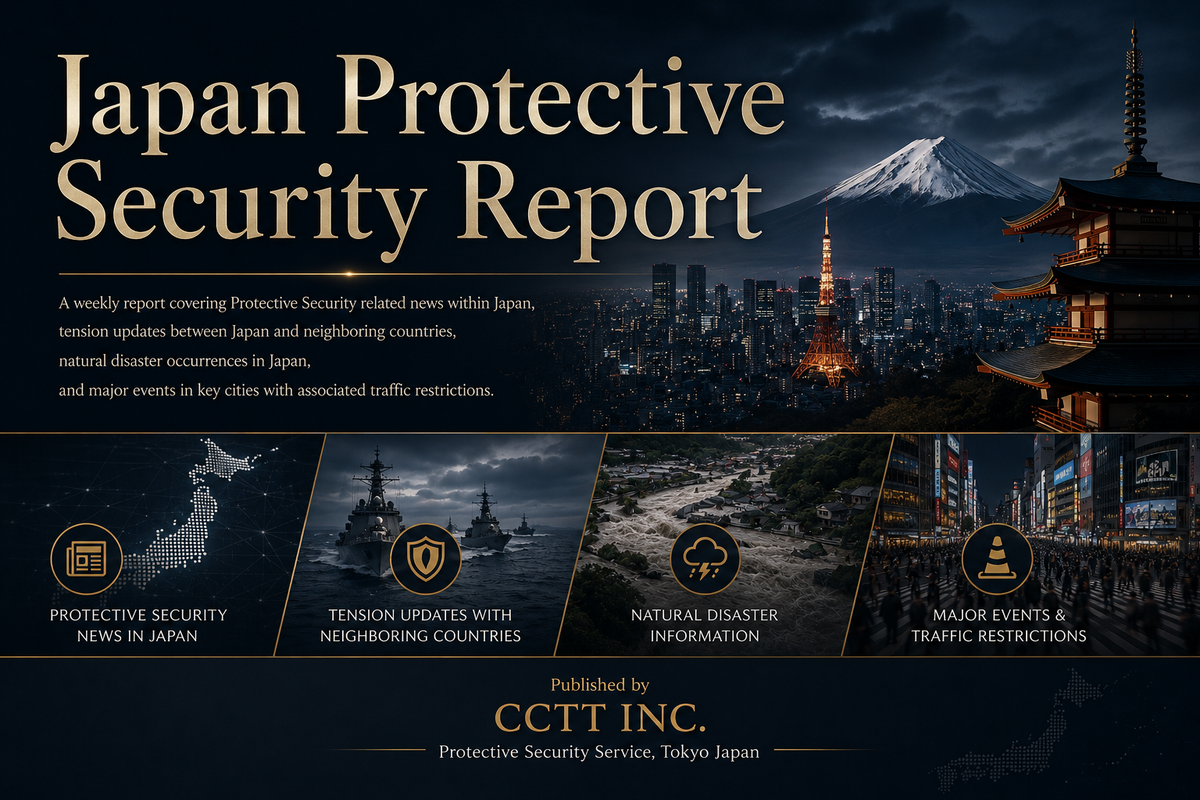
Japan Protective Security Report (Weekly)
Report: July 15 – July 22, 2026
Published: Wednesday, July 22, 2026 (JST)
A weekly English-language OSINT briefing for executive protection professionals, bodyguards, and corporate security managers operating in or visiting Japan.
🔒 Section 1: Weekly Security News Summary
Vehicle Rams Convenience Store in Kanagawa; Police Fire Warning Shot
A police officer fired a warning shot after a vehicle rammed into a convenience store in Sagamihara, Kanagawa Prefecture, early on July 20. Police said a man armed with a kitchen knife was found in the parking lot, and a 15-year-old customer inside the store suffered minor injuries after being hit by the vehicle. The suspect was arrested on suspicion of violating the firearms and swords control law, and police also investigated a related fire at a nearby apartment.
Source: The Japan Times
💡Tips for Professionals:
This incident underlines how quickly a routine retail or rest-stop environment can turn into a mixed vehicle-impact, edged-weapon, and fire-related threat. EP/CP teams using convenience stores as short stops should avoid placing principals near glass frontage, maintain a clear vehicle exit lane, and assign one team member to observe the parking area during stops. Trainers should include “low-profile roadside stop” drills that cover vehicle intrusion, knife threat, police arrival, and rapid relocation.
Irritant Spray Incident Injures Students at Osaka Junior High School
More than 20 people were injured after an unknown substance was sprayed at a junior high school in Osaka on July 17. Authorities treated the incident as a school safety and chemical-irritant event, with students reporting symptoms after exposure. The case is relevant because schools, campuses, and education venues often host visiting executives, families, and foreign guests during community or corporate activities.
Source: The Japan Times
💡Tips for Professionals:
Protective teams should treat schools and event venues as soft targets where access control may be lighter than at corporate facilities. For visits involving families, students, or youth programs, advance work should confirm evacuation routes, first-aid capability, ventilation control, and the nearest safe holding area. Teams should also carry basic PPE and have a decontamination and medical handoff plan for irritant exposure.
Four Served Fresh Warrants over Haneda Attempted Robbery Case
Four suspects were served fresh warrants in connection with an attempted robbery case linked to a large cash ambush near Haneda Airport. Earlier reporting described the case as involving an attempted theft before a cash-related attack, suggesting planning, target selection, and possible misidentification of the intended victim. For international visitors, the case highlights that airport-adjacent areas are not risk-free, especially when movements involve visible cash, high-value goods, or predictable transfers.
Source: Jiji Press
💡Tips for Professionals:
Airport transfer plans should avoid predictable curbside waiting, visible cash handling, and long dwell times in public loading zones. EP teams should coordinate vehicle staging, meet-and-greet positioning, and contingency routes before arrival, especially at Haneda and Narita. Corporate security managers should remind travelers that “Japan is safe” does not remove the need for secure ground transport when high-value movements are involved.
Nichirei Cyberattack Disrupts Logistics and Food Supply Chain
Nichirei, one of Japan’s major frozen food companies, worked to restore systems after a cyberattack disrupted operations and affected supplies to customers including KFC Japan. NHK reported that the company restarted some computer systems after the incident, while The Japan Times reported that full recovery was expected as operations came back online. The case shows how cyber incidents can create physical-world effects for food logistics, retail operations, and event supply chains.
Source: NHK World-Japan, The Japan Times
💡Tips for Professionals:
Corporate security teams should treat major supplier cyber incidents as operational-continuity risks, not only IT issues. EP teams supporting events, conferences, or multi-day visits should verify food, catering, cold-chain, and hotel supply dependencies when a major logistics provider is affected. Business continuity plans should include substitute vendors, manual ordering procedures, and a communication channel between IT, facilities, travel, and executive support teams.
Former Nurse in Chiba Suspected of Killing Patient by Contaminating IV
Japanese police investigated a former nurse in Chiba Prefecture on suspicion of killing a patient by contaminating an intravenous drip with fecal matter. The case is a serious reminder that insider threats can emerge in medical and care environments, where vulnerable individuals and high-profile patients may rely heavily on staff trust. For protective operations, medical visits should be treated as controlled environments requiring their own advance procedures.
Source: The Japan Times
💡Tips for Professionals:
When a principal receives medical care in Japan, protective staff should coordinate with facility management on access control, visitor logs, and staff identification without interfering with clinical work. High-profile or sensitive patients may require discreet monitoring of room access, medication handling boundaries, and after-hours movement. Security managers should include medical-facility liaison procedures in travel and residential protection plans.
Kudokai Yakuza Group Undergoes Leadership Change
The Kudokai, a yakuza group historically known for violence against civilians and businesses, underwent a leadership change. While Japan’s organized-crime environment remains tightly monitored, leadership transitions can affect local criminal dynamics, extortion risks, and pressure on nightlife or construction-related sectors. The development is particularly relevant for operations in Kyushu and for clients with exposure to hospitality, entertainment, real estate, or local contracting.
Source: The Japan Times
💡Tips for Professionals:
EP/CP teams operating in regional nightlife districts should use vetted venues, avoid informal local introductions, and maintain a conservative posture around entertainment-area movements. Corporate security managers should ensure vendor due diligence covers organized-crime exclusion clauses and beneficial ownership checks. Training programs should distinguish between street-crime risk and organized-crime exposure, as the indicators and response options are different.
Japan Moves Forward with AI-Linked Policy and Governance Measures
Japan continued advancing AI-linked policy and governance initiatives, including plans to promote AI-related reform and coordination. While the policy topic is not a physical security incident, it is relevant to corporate security because AI misuse, impersonation, synthetic media, and cyber-enabled fraud are increasingly connected to executive protection and corporate risk. Japan’s public-policy movement signals that AI governance will remain a live issue for companies operating in the country.
Source: Jiji Press
💡Tips for Professionals:
Security managers should update executive-protection procedures to include AI-enabled impersonation, fake itinerary messages, voice-clone calls, and fraudulent vendor instructions. EP teams should use verified callback procedures for last-minute movement changes, especially when messages appear to come from executives, family offices, or overseas assistants. Training should include examples of deepfake-enabled social engineering targeting drivers, hotels, reception desks, and event staff.
Akashi Crowd-Crush Anniversary Highlights Mass-Gathering Risk
Japan marked 25 years since the Akashi pedestrian bridge crowd crush, a disaster that remains a major reference point for crowd safety and event-policing lessons. Although the anniversary itself was commemorative, the case is operationally relevant during Japan’s summer festival and fireworks season, when crowd density, heat, station bottlenecks, and limited egress can combine. Inbound visitors often underestimate crowd-management risks at Japanese festivals because the general public order level is high.
Source: The Japan Times
💡Tips for Professionals:
Protective teams should not enter festival or fireworks crowd flows without a pre-identified exit route, rally point, and vehicle extraction plan. For principals attending public events, arrival and departure timing should avoid peak station surges and post-event compression. Corporate security managers should brief visitors that crowd safety, heat management, and rail-station congestion may be more relevant than violent crime during summer events.
🌏 Section 2: Japan–Foreign Nations Tension Monitor
1. China – Tension Level: High
Japan protested after a Chinese destroyer conducted live-fire drills inside Japan’s exclusive economic zone near Okinotorishima, with Russian vessels also observed nearby. Reuters reported that Tokyo said the activity could endanger nearby vessels, while Beijing rejected Japan’s position and argued that Japan was not entitled to claim the waters as an EEZ around Okinotorishima. The incident was notable because Japan publicly acknowledged such a Chinese live-fire drill in its EEZ for the first time.
Source: Reuters, The Japan Times
💡Tips for Professionals: China-related tensions can trigger protests, diplomatic security adjustments, and heightened attention around Chinese, Taiwanese, Philippine, and Japanese government-linked venues. EP teams should monitor embassy-area demonstrations, maritime-sector events, and policy conferences where activist presence or media concentration may increase.
2. Russia – Tension Level: Elevated
Russian naval vessels were observed near the Chinese live-fire drill area, and Japan’s Defense Ministry said the Maritime Self-Defense Force conducted warning and surveillance activities. The development followed a pattern of closer China-Russia military coordination around Japan, including joint naval and air activity. While Russia was not the direct target of Japan’s protest in the same way as China, the combined presence increases regional-security sensitivity.
Source: Jiji Press, NHK World-Japan
💡Tips for Professionals: Teams supporting Russian, Ukrainian, defense-industry, or diplomatic principals should assume that related public events may attract heightened attention. Route planning around embassies, defense facilities, and international conferences should include protest monitoring and media-management contingencies.
3. North Korea – Tension Level: Moderate
North Korea continued rhetorical criticism of Japan’s defense posture, with Reuters reporting earlier in July that North Korean state media accused Japan of turning military expansion into reality. The rhetoric fits a continuing pattern of pressure over Japan’s defense modernization, missile-defense posture, and regional cooperation with the United States and South Korea. No direct Japan-targeted missile event was reported during this period, but the baseline threat environment remains relevant.
Source: Reuters
💡Tips for Professionals: Protective teams should keep missile-alert procedures, shelter-in-place guidance, and client communication templates ready even when there is no active launch alert. Corporate security managers with overseas staff in Japan should confirm that visitors understand J-Alert messages and know where to take shelter if instructed.
4. Philippines-Related China Tension Affecting Japan – Tension Level: Moderate
China maintained opposition to Japan-Philippines maritime boundary talks, arguing that the talks affect waters near Taiwan and overlap with Chinese claims. Jiji reported that Chinese official ships continued operations east of Taiwan, while The Japan Times has noted that Beijing sees Tokyo-Manila maritime coordination as part of broader strategic alignment among U.S. partners. This is not a bilateral Japan-Philippines tension issue, but it directly affects Japan-China risk calculations.
Source: Jiji Press, The Japan Times
💡Tips for Professionals: Events involving Philippine officials, maritime law, Taiwan policy, or Indo-Pacific security may carry a higher protest and media profile. Security teams should monitor venue access, counter-protest potential, and online mobilization around these themes before public engagements.
🌋 Section 3: Natural Disaster Report
Dangerous Heatwave and End of Rainy Season Across Japan
Japan experienced dangerous heat during the reporting period, with temperatures exceeding 35°C in many areas and forecasts reaching or exceeding 40°C in some cities by July 22. The Japan Times reported that the rainy season had officially ended in several regions and that Tokyo recorded its first extremely hot day of the year, while Reuters reported that the government’s new “brutally hot day” designation applied as life-threatening heat spread. NHK also reported that 4,580 people were transported to hospitals for heatstroke during July 6–12, more than triple the previous week, with seven deaths recorded in that earlier dataset.
Source: The Japan Times, Reuters, NHK World-Japan
Tropical Disturbances and Heavy-Rain Risk Around Southern and Northern Japan
Japan also monitored unsettled weather linked to tropical systems and developing disturbances south of the country. The Japan Times reported that Tropical Storm Bavi had affected the Sakishima Islands before moving toward China, with moisture and strong winds expected to affect northern Japan as the system transitioned. No large-scale domestic disaster damage requiring a separate national disaster response was confirmed in the cited reporting, but the weather pattern increased travel and operational-continuity risk.
Source: The Japan Times, Japan Meteorological Agency
💡Tips for Professionals — Natural Disaster / Operational Continuity:
Heat is the primary operational hazard for the July 22–29 period. EP teams should reduce outdoor dwell time, pre-cool vehicles, carry oral rehydration supplies, and monitor principals, drivers, interpreters, and advance staff for heat stress rather than focusing only on the principal. For road movements and outdoor events, plan shaded holding areas, backup indoor waiting points, and flexible arrival times because heat illness, sudden storms, and rail disruption can affect both the team and the surrounding crowd.
📅 Section 4: Upcoming Major Events & Traffic Restrictions
Tokyo
- TV Asahi / Roppongi Hills SUMMER FES: ARIAKE SUMMER FES at TOKYO DREAM PARK – July 18 – August 23, 2026
- Location: TOKYO DREAM PARK, Ariake, Koto-ku; access via Yurikamome “Tokyo Big Sight” Station and Rinkai Line “Kokusai-Tenjijo” Station.
- Traffic: No dedicated road closure was confirmed in the official event listing, but the Ariake and Odaiba waterfront area may see increased pedestrian flows, taxi demand, parking pressure, and station congestion, especially on weekends and event evenings.
- Source: TokyoOdaiba.net
- Tokyo Big Sight / Ariake Event Cluster – July 22 – July 29, 2026
- Location: Tokyo Big Sight and Ariake GYM-EX area.
- Traffic: Tokyo Big Sight’s visitor schedule shows continuing and upcoming trade/public events around the waterfront area. Expect congestion around Kokusai-Tenjijo, Tokyo Big Sight Station, Ariake, Toyosu, and nearby hotel drop-off points; verify real-time road and parking conditions before VIP arrival.
- Source: Tokyo Big Sight
- Tokyo Metropolitan Police Department Traffic Information Portal – July 22 – July 29, 2026
- Location: Tokyo metropolitan road network.
- Traffic: No single citywide VIP road closure was confirmed in the searched results for this reporting window, but teams should check the MPD traffic portal before same-day movements because temporary restrictions, demonstrations, accidents, and roadworks can change rapidly.
- Source: Tokyo Metropolitan Police Department
- JR East Real-Time Train Status and Delay Certificates – July 22 – July 29, 2026
- Location: Greater Tokyo rail network.
- Traffic: JR East’s real-time train information and delay certificate systems should be checked before airport transfers, Shinkansen connections, and principal movement via Tokyo, Shinagawa, Shinjuku, Shibuya, Ueno, and Ikebukuro. Heat, passenger illness, and equipment trouble can produce sudden delays during summer peaks.
- Source: JR East Train Status Information, JR East Delay Certificate
💡Tips for Professionals: For Tokyo movements this week, avoid assuming that “no official road closure” means low operational risk. The main practical risks are heat, waterfront event congestion, station crowding, taxi shortages, and sudden rail disruption. Build extra time into Ariake, Odaiba, Toyosu, Haneda, Tokyo Station, and Shinagawa movements, and keep a road-and-rail fallback plan available.
Osaka
- Tenjin Festival Season – July 24 – July 25, 2026
- Location: Kita area, Osaka, including areas around Osaka Tenmangu and central waterways.
- Traffic: Osaka’s official tourism information lists Tenjin Festival as a major seasonal event. Large crowds, pedestrian concentration, riverfront viewing, and station congestion should be expected; confirm local police and city traffic-control notices before any principal visit.
- Source: OSAKA-INFO
- JR Takarazuka Line Night Maintenance and Substitute Bus Operations – July 2026
- Location: JR Takarazuka Line area.
- Traffic: JR West announced night-time service suspensions and substitute bus transport related to concentrated maintenance work. Teams using rail movements between Osaka and Hyogo should verify last-train and alternative-route options before evening movements.
- Source: JR West
💡Tips for Professionals: Osaka’s Tenjin Festival period requires festival-specific route planning. Avoid riverfront crowd compression, do not rely on taxis immediately after major festival events, and use hotel-side staging areas away from the densest pedestrian routes. If rail is used, check JR West and Osaka Metro information before movement.
Nagoya
- POP IS YOU SAKAE26 and Summer Visitor Events – July 22 – August 16, 2026
- Location: Sakae area and central Nagoya cultural/commercial districts.
- Traffic: Nagoya’s official visitor guide lists summer events beginning July 22 in the Sakae area. Expect pedestrian congestion around Sakae, Hisaya-odori, department stores, event venues, and subway access points.
- Source: Visit Nagoya
- Central Japan Expressway Traffic and Safety Information – July 22 – July 29, 2026
- Location: NEXCO Central expressway network serving Tokyo, Nagoya, Shizuoka, Yamanashi, and surrounding areas.
- Traffic: NEXCO Central’s driver site should be checked before intercity protective movements because summer travel, accident investigations, and roadworks may create sudden lane restrictions or closures. A listed example included a Shin-Tomei Expressway closure for accident investigation on July 25.
- Source: NEXCO Central
💡Tips for Professionals: For Nagoya and central Japan movements, plan around heat, underground mall complexity, and road congestion on expressway approaches. EP drivers should check NEXCO Central and JARTIC-style road information before departure and avoid committing to a single expressway route without an alternate.
Kyoto, Fukuoka, Sapporo, and Other Major Cities
- Heat and Weather-Driven Travel Risk Across Major Cities – July 22 – July 29, 2026
- Location: Nationwide, with particular attention to urban tourist areas, festival districts, and intercity rail corridors.
- Traffic: No single major road closure was confirmed in the searched official sources for Kyoto, Fukuoka, or Sapporo during this exact reporting window, but extreme heat and summer event crowds may affect walking routes, outdoor queues, taxi availability, and rail station dwell time.
- Source: Japan Meteorological Agency, Reuters
💡Tips for Professionals: For secondary cities, the main protective-security issue this week is not a named road closure but heat-related operational degradation. Use shorter walking routes, shaded entrances, indoor holding rooms, and earlier arrivals. For inbound visitors, confirm hotel air-conditioning, vehicle cooling time, and hydration logistics before the movement day.
Japan Protective Security Report (Weekly)
This report is based on open-source intelligence (OSINT) gathered from publicly available, high-credibility sources. It does not constitute legal advice, and CCTT INC. makes no warranty regarding completeness or accuracy. Operational decisions should always incorporate real-time local intelligence.
CCTT INC. – Protective Security Service, Tokyo Japan
VIP/Executive Protection | Celebrity Protection | Vehicle and Driver Arrangement | Airport Service Arrangement | Security Consulting | Security Management | Security Education/Training, etc.