Report: July 1 – July 8, 2026
Japan Protective Security Report (Weekly)
Report: July 1 – July 8, 2026
Published: Wednesday, July 8, 2026 (JST)
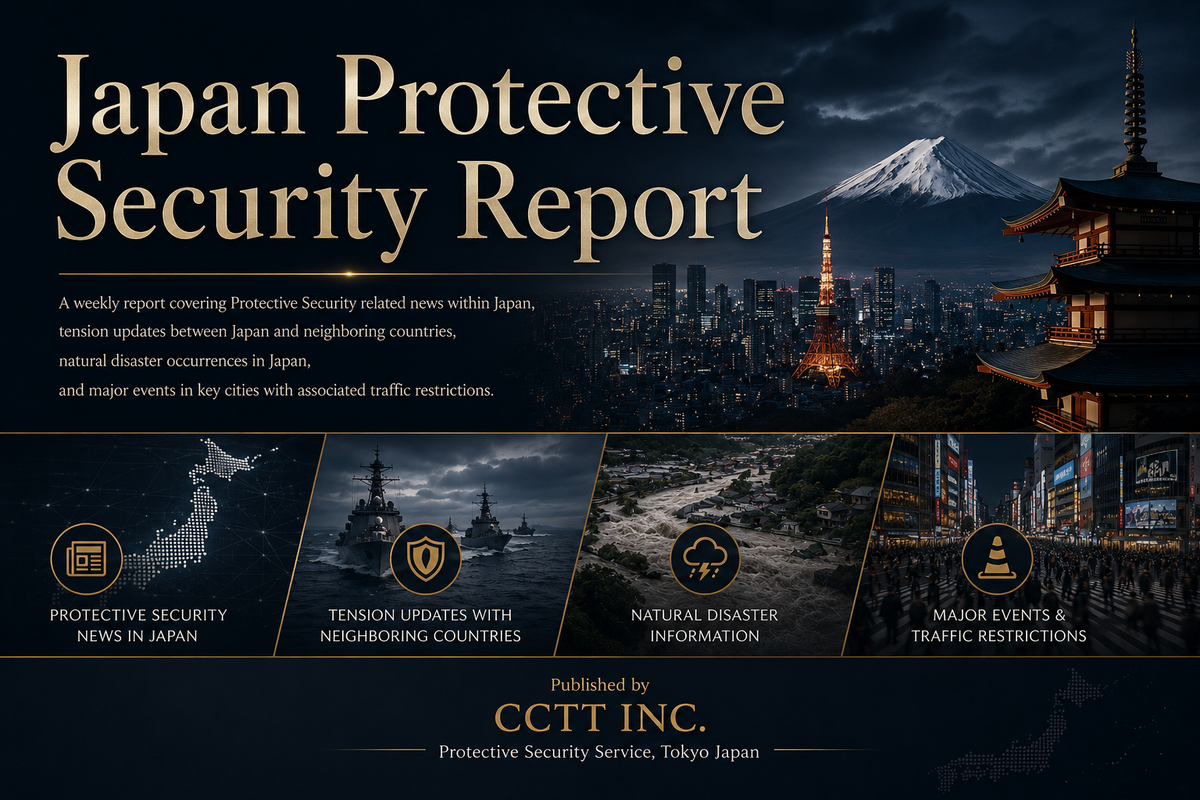
A weekly English-language OSINT briefing for executive protection professionals, bodyguards, and corporate security managers operating in or visiting Japan.
🔒 Section 1: Weekly Security News Summary
Tokyo police arrest suspected “tokuryu” robbery planner linked to Tachikawa home invasion
Tokyo police arrested a 26-year-old man believed to have acted as a robbery planner within a “tokuryu” loosely organized anonymous criminal group. Investigators suspect the man conspired with others to break into a Tachikawa residence in December and steal cash and valuables, with proceeds later exchanged at an expressway rest stop. Reporting indicated that the suspect and another indicted individual met through social media and discussed targeting safes and gold bars.
Source: Nippon.com / Jiji Press[3]
💡Tips for Professionals:
Residential protection teams in Tokyo should treat “tokuryu” robbery groups as capable of basic target selection, online recruitment, role separation, and post-crime movement through highway rest areas. For executive residences, review safe placement, home-office routines, exterior lighting, door and window reinforcement, and CCTV coverage of approach routes. Drivers and EP teams should also treat expressway service areas and parking areas as potential handoff or surveillance locations, not just rest stops.
Japanese police arrest nine over Sierra Leone-based special fraud operation
Japanese police arrested nine individuals for alleged involvement in a special fraud case using Sierra Leone as an overseas base. The suspects were believed to have acted as callers, impersonating Osaka District Public Prosecutors Office staff and allegedly defrauding a woman in Sapporo of ¥55 million. The case reinforces the continued globalization of Japanese special-fraud operations and the use of overseas call centers against Japan-based victims.
Source: The Japan Times[1]
💡Tips for Professionals:
EP teams, family offices, and corporate security managers should brief principals and assistants that prosecutor, police, bank, and account-compromise calls may originate from overseas while still using Japan-specific language and procedures. Establish a strict callback protocol using verified official numbers, not numbers provided by callers. For elderly family members of principals, prepare a written fraud-response card that states who to call before transferring funds or disclosing account information.
Police move to crack down on fraud-linked social media posts
Japanese police are working to strengthen countermeasures against social media posts linked to special fraud and illegal recruitment. The issue is closely connected to “yami baito” and “tokuryu” recruitment, where individuals are drawn into criminal roles through online offers promising quick money. Such online recruitment can create sudden local crime risks because offenders may have little prior criminal history but are directed by remote organizers.
Source: Nippon.com / Jiji Press[99]
💡Tips for Professionals:
Corporate security teams should include “easy money” recruitment, account-selling, SIM misuse, and parcel/cash pickup roles in staff security education, especially for younger workers, interns, and contractors. EP trainers should update Japan threat briefings to explain that attackers may be disposable recruits rather than long-term organized-crime members. For household staff and drivers, suspicious requests to receive packages, open accounts, rent phones, or move cash should be escalated immediately.
Four arrested over attempted theft before Haneda Airport cash ambush
Tokyo police arrested four people over an attempted theft at a multistory parking lot at Haneda Airport in January. The case was reported in connection with a broader cash-related ambush investigation, with police believing that one suspect directed the operation. Airport parking facilities, vehicle waiting areas, and curbside zones remain important exposure points for principals carrying cash, valuables, or sensitive equipment.
Source: The Japan Times[6]
💡Tips for Professionals:
Airport movements should be treated as protective operations from aircraft door to final vehicle departure, not merely as transport. For Haneda and Narita, reduce stationary dwell time in parking structures, avoid visible cash or luxury-goods handling, and pre-confirm vehicle location before the principal exits secure areas. If cash, watches, jewelry, or business samples are involved, use a controlled meet-and-assist process with separate roles for principal movement, baggage control, and counter-surveillance.
Teen arrested for disrupting tens of thousands of streaming-service accounts
Tokyo police arrested a 15-year-old high school student on suspicion of obstructing business by exploiting a system vulnerability and fraudulently canceling approximately 46,800 Bandai Channel accounts. The Metropolitan Police Department’s cybercrime division handled the case, and the service was briefly suspended. Although the incident was digital, it is relevant for security managers because consumer-service disruptions can create reputational pressure, help-desk overload, and potential escalation toward offices or executives.
Source: The Japan Times[2]
💡Tips for Professionals:
Corporate security managers should ensure that cyber incidents are integrated into physical-security and business-continuity planning. If a consumer-facing platform fails, expect increased call volume, online anger, possible visits to offices or stores, and executive attention. EP teams supporting technology, entertainment, gaming, or media executives should monitor whether a cyber incident creates public-facing movement risk at headquarters, studios, events, or shareholder meetings.
Suspected Asian fraud-ring executive served fresh warrant in Japan
Japanese police served fresh arrest warrants on three people, including a man believed to be an executive of one of Asia’s largest international fraud organizations, for alleged immigration-control violations involving a residence card. The suspect is believed by investigators to be linked to a major international fraud organization subject to sanctions by U.S. authorities and others. The case highlights the overlap between immigration-status abuse, fraud infrastructure, and Japan-based operational footholds.
Source: Nippon.com / Jiji Press[7]
💡Tips for Professionals:
Corporate security teams should not treat document irregularities, false address filings, or residence-card misuse as purely administrative issues when fraud networks are suspected. For office buildings, serviced apartments, and executive residences, verify tenant, contractor, and visitor identity through reliable procedures rather than relying only on presented documents. EP teams supporting fraud-sensitive clients should consider whether nearby units, coworking spaces, or short-term rentals could be used as logistics nodes.
Man arrested after ex-wife and daughter found dead in Nagano
Nagano Prefectural Police arrested a 46-year-old man after his ex-wife and their daughter were found dead at their home in Tomi, Nagano Prefecture. The case remains relevant to protective security because family, domestic, and ex-partner violence can escalate quickly and often occurs in or near residences. Such cases may not initially appear as “public security” incidents but can become direct threats to principals, family members, or staff.
Source: The Japan Times[23]
💡Tips for Professionals:
Protective-intelligence intake should include domestic conflict, divorce, custody, stalking, and unwanted-contact history, especially for principals with family members in Japan. EP teams should tighten arrival and departure routines at residences when there is known family conflict or a recent separation. Corporate security managers should ensure employees understand how to escalate domestic-violence concerns that may affect workplace safety or business travel.
🌏 Section 2: Japan–Foreign Nations Tension Monitor
1. China – Tension Level: High
China and Japan reported conflicting accounts of a July 7 confrontation near the Senkaku Islands involving coast guard vessels and a Japanese fishing boat. Japan’s coast guard said it expelled two Chinese coast guard vessels that approached a Japanese fishing boat, while China claimed it had expelled a Japanese vessel from waters it claims. Separately, Japanese reporting said two Chinese coast guard ships entered Japanese territorial waters off the Senkaku Islands before leaving later the same morning.
Source: Reuters[27] | Nippon.com / Jiji Press[26]
💡Tips for Professionals:
For principals traveling to Okinawa, Ishigaki, Miyako, or maritime-facing locations, maintain a standing maritime-security check before movement. Heightened Senkaku activity can increase police, coast guard, media, and protest sensitivity around ports, airports, and government facilities. Corporate security teams supporting China-linked, Taiwan-linked, or defense-adjacent clients should review itinerary confidentiality and avoid unnecessary exposure near symbolic locations.
2. China – Tension Level: Elevated
China test-fired a missile from a nuclear submarine into the Pacific, drawing concern from Japan, Australia, and New Zealand. Japan said it had been notified and expressed grave concern over increased Chinese military activity, while reporting indicated the missile landed outside Japan’s exclusive economic zone. The launch adds to the broader security environment affecting Japan’s maritime and air posture.
Source: Reuters[29]
💡Tips for Professionals:
EP teams should treat missile tests and military-notification events as possible triggers for increased security sensitivity even when there is no direct impact on Japanese territory. For coastal, port, and airport movements, confirm local advisories and avoid unnecessary public commentary by principals on Taiwan, China, or defense issues. Corporate security teams should brief travelers that geopolitical incidents can affect public mood, media attention, and routing near government or diplomatic facilities.
3. China / Economic Security – Tension Level: Elevated
Corporate Japan’s concern over rare-earth and critical-mineral supply tightened further as China maintained restrictions affecting Japanese companies. Reuters reported that shortages are beginning to affect the broader Japanese economy, increasing urgency for Japan to find alternatives to Chinese exports. This issue connects economic security, defense-related supply chains, and corporate operational resilience.
Source: Reuters[28]
💡Tips for Professionals:
Corporate security managers should treat rare-earth and dual-use supply-chain exposure as a travel-risk and information-security issue, not only a procurement problem. Executives in semiconductors, automotive, batteries, robotics, defense, and advanced manufacturing may face heightened media interest, competitive intelligence collection, or regulatory scrutiny. EP teams should reinforce device hygiene, meeting confidentiality, and low-profile movement for principals involved in China-sensitive supply chains.
4. Russia – Tension Level: Moderate
Russia’s envoy indicated an intention to skip the Hiroshima Peace Memorial Ceremony on August 6. While not a direct physical threat, the diplomatic absence reflects continued tension around Russia’s position in Japan’s public commemorative and diplomatic environment. Such symbolic events can attract political messaging, protest activity, and media scrutiny.
Source: Nippon.com / Jiji Press[24]
💡Tips for Professionals:
For August planning in Hiroshima, Tokyo, or other symbolic venues, monitor diplomatic attendance, protest notices, and media positioning early. EP teams should avoid assuming peace-related ceremonies are low-risk simply because they are solemn events. Corporate security managers supporting politically exposed or diplomatic principals should prepare alternate entry and exit options around commemoration sites.
🌋 Section 3: Natural Disaster Report
Earthquake: M5.1 in northern Miyazaki Prefecture, no tsunami concern
An earthquake occurred at around 8:40 a.m. on July 1, with maximum seismic intensity 4 observed in areas including Nobeoka, Miyazaki Prefecture. The epicenter was in the northern Miyazaki plain, with a depth of about 10 km and an estimated magnitude of 5.1. No tsunami concern was reported.
Source: Mainichi Shimbun[58]
JMA earthquake information availability and operational monitoring
The Japan Meteorological Agency’s earthquake information map and detail pages remained the primary official source for earthquake verification, although some live map pages may require JavaScript or return limited text through automated fetch. For operational use, teams should check JMA pages directly during the movement window rather than relying only on secondary aggregators. This is especially important when deciding whether to continue movement after felt shaking.
Source: Japan Meteorological Agency[75] | Japan Meteorological Agency Earthquake Detail[76]
Weather and short-fuse heavy-rain monitoring
JMA short-term precipitation forecast products remained relevant during the reporting period as Japan moved deeper into summer storm and heavy-rain risk season. Even when no single nationwide disaster dominates the week, short-fuse rainfall can affect underpasses, hillside roads, rail operations, and event access within hours. For protective movement, real-time rain monitoring is an operational requirement rather than a weather curiosity.
Source: Japan Meteorological Agency[77]
💡Tips for Professionals — Natural Disaster / Operational Continuity:
For Kyushu and other rain-prone regions, drivers should check JMA nowcasts before departure and again before entering mountain roads, low-lying underpasses, or coastal routes. After any felt earthquake, complete an immediate accountability check, confirm elevator and rail status, and avoid glass-heavy drop-off points until aftershock risk is understood. EP teams should maintain a simple “pause, verify, reroute” protocol for earthquakes and heavy rain, using JMA as the primary reference and local transport operators for movement decisions.
📅 Section 4: Upcoming Major Events & Traffic Restrictions
Tokyo
- Shitamachi Tanabata Festival – July 3 (Fri) – July 8 (Wed), 2026
- Location: Kappabashi Main Street area, Taito City.
- Traffic: Expect pedestrian crowding and localized traffic difficulty around Kappabashi, Ueno, and Asakusa approaches during the final festival day. Vehicle access close to the main pedestrian corridor may be slow or impractical.
- Source: Taito City
- World DJ Festival Japan 2026 related facility-use restrictions – June 29 (Mon) – July 8 (Wed), 2026
- Location: Umi no Mori area, Tokyo.
- Traffic: Event-related facility-use restrictions remain relevant through July 8. Expect access control, localized congestion, and limited approach options around the Umi no Mori venue footprint.
- Source: Umi no Mori Park
- Tokyo Big Sight event schedule – July 8 (Wed) – July 15 (Wed), 2026
- Location: Tokyo Big Sight, Ariake/Odaiba area.
- Traffic: Large exhibitions can increase taxi queues, charter-bus loading, and crowding on Yurikamome and Rinkai Line services. Morning opening and late-afternoon closing waves should be treated as higher-friction movement windows.
- Source: Tokyo Big Sight
- Tokyo Metropolitan Police Department traffic information portal – Continuous, next 7 days
- Location: Tokyo metropolitan area.
- Traffic: MPD traffic pages should be checked on the day of movement for event-related restrictions, incident information, and road-safety notices. If an event-specific page is temporarily inaccessible, cross-check organizer and ward-level official notices.
- Source: Tokyo Metropolitan Police Department
Tips for Professionals — Tokyo:
For Asakusa, Ueno, and Kappabashi-area movements on July 8, avoid direct vehicle insertion into festival-adjacent streets and pre-set pickup points one or two blocks outside the main pedestrian flow. For Umi no Mori and Odaiba/Ariake movements, treat waterfront access as a bottleneck and prepare secondary staging away from the venue perimeter. EP teams should check MPD, ward, and organizer pages on the day of movement because short-notice controls may not appear in general event calendars.
Osaka / Kansai
- JR West operational status monitoring – Continuous, next 7 days
- Location: Kansai-area rail network and Shinkansen connections.
- Traffic: Rail operations may change due to weather, incidents, or equipment issues. Teams using rail for principal or staff movement should confirm status before departure and again before transfer.
- Source: JR West Traffic Information
- Sanyo Line daytime construction-related substitute bus operations – July period, check dates before movement
- Location: Tokuyama–Shin-Yamaguchi section, Sanyo Line.
- Traffic: Substitute bus operations and construction-related timetable changes may affect western Japan rail movement and onward connections.
- Source: West Japan Railway Company[57]
Tips for Professionals — Osaka / Kansai:
Rail-dependent itineraries should include an alternate plan before the principal enters the station, not after a delay appears. For westbound movements, confirm whether construction or substitute bus operations affect connection times, baggage handling, and driver positioning. Corporate security teams should avoid scheduling tight rail-to-airport transfers during heavy-rain or construction windows.
Shikoku
- JR Shikoku Yodo Line partial suspension – July 7 (Tue) – July 8 (Wed), 2026
- Location: Yodo Line, Shikoku.
- Traffic: Partial suspension may affect regional movement and local itinerary timing. Confirm replacement transport, road access, and station pickup arrangements before dispatch.
- Source: JR Shikoku
Tips for Professionals — Shikoku:
For regional protection operations, do not assume rail coverage is resilient in rural areas. If a local rail segment is suspended, confirm whether road alternatives are narrow, weather-exposed, or unsuitable for larger vehicles. Drivers should be staged early, and teams should carry offline maps in case mobile coverage is weak.
Nagoya / Central Japan
- Central Japan expressway disruption monitoring – Continuous, next 7 days
- Location: NEXCO Central jurisdiction, including Tokai and Chubu corridors.
- Traffic: Weather-related restrictions, traffic incidents, and congestion can affect movement between Nagoya, industrial sites, and regional airports.
- Source: NEXCO Central
Tips for Professionals — Nagoya / Chubu:
For executive movements between Nagoya and surrounding industrial hubs, prepare alternatives that avoid single-point-of-failure interchanges. During heavy rain, confirm road conditions earlier than usual and authorize drivers to reroute when delay thresholds are met. Maintain offline route options in case mobile navigation becomes unreliable.
Japan Protective Security Report (Weekly)
This report is based on open-source intelligence (OSINT) gathered from publicly available, high-credibility sources. It does not constitute legal advice, and CCTT INC. makes no warranty regarding completeness or accuracy. Operational decisions should always incorporate real-time local intelligence.
CCTT INC. – Protective Security Service, Tokyo Japan
VIP/Executive Protection | Celebrity Protection | Vehicle and Driver Arrangement | Airport Service Arrangement | Security Consulting | Security Management | Security Education/Training, etc.